Which of the Following Activities Does Not Require Irb Review?
Decision Chart | Comprehensive Comparison Table | Definitions | Public Wellness Surveillance
Brown's IRB has bodacious federal regulatory agencies that the institution will review and approve all enquiry that meets the federal definition of human subject research. Determining whether or not a projection meets the federal definition of human subjects enquiry is a two-step process. The investigator must get-go determine if the project meets the federal definition of enquiry and, if and so, then determine if the project includes man subjects.
In add-on to the information below, the Brown HRPP has provided cocky-assessment resources for students and researchers to employ to determine if their project requires IRB review:
- The Self-determination tools and checklists are guides to assist Brownish researchers in complying with federal regulations and institutional policy.
- The NIH Decision Tool: Am I Doing Man Subjects Research? Developed past NIH to help you decide if your research involves human subjects, may exist exempt from federal regulations, or is non considered human being subjects research.
- Is it Human being Subjects Research? Is IRB Review Required? educational video from HRPP's Learning Library.
Decision Chart
A decision chart to assistance guide researchers in making a determination of whether they're conducting homo discipline research and demand to submit an IRB Application.
Step 1: Is your Project Considered Inquiry?
Federal regulation defines "research" as a systematic investigation, including enquiry evolution, testing, and evaluation, that is designed to develop or contribute to generalizable knowledge.
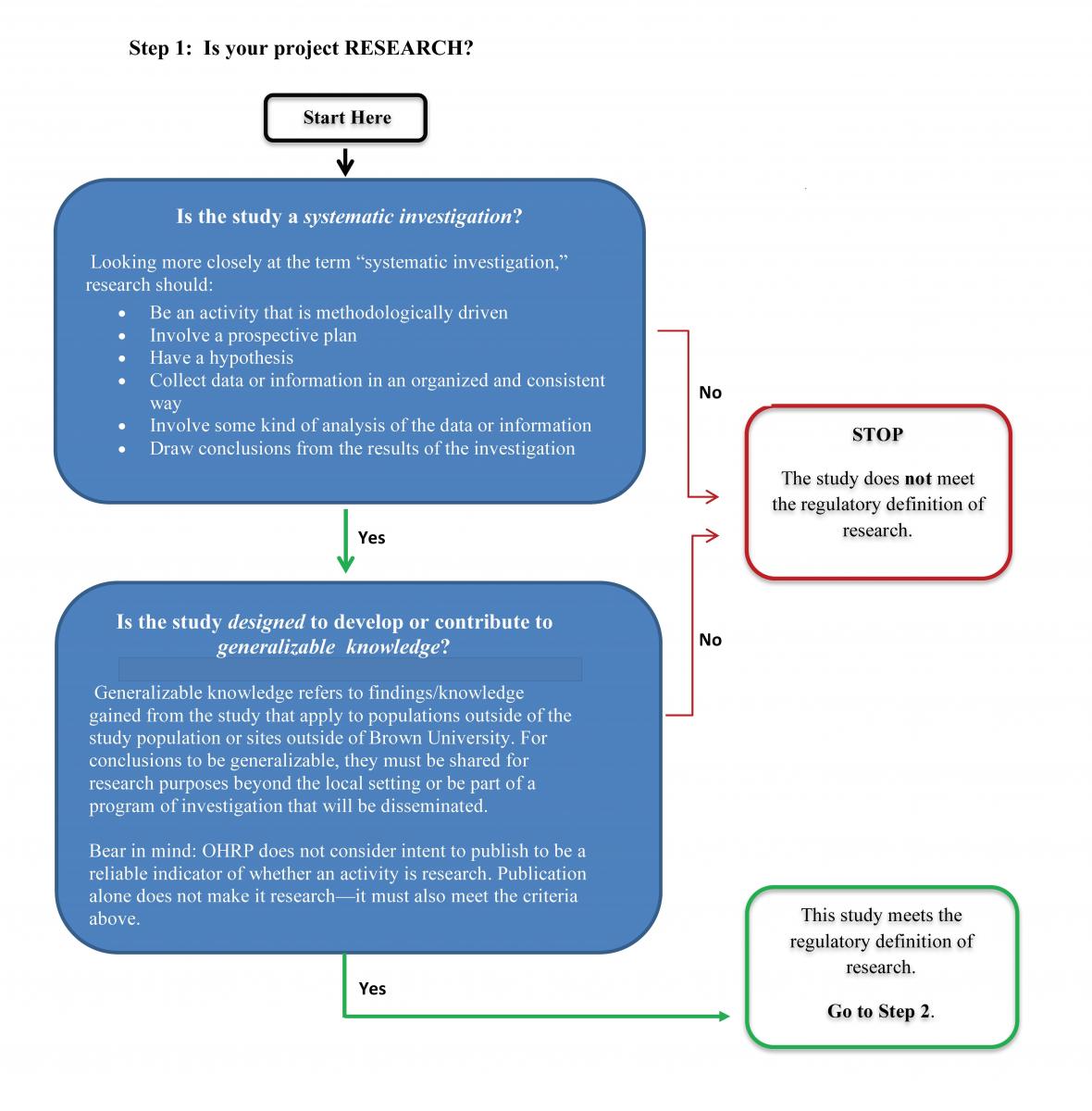
Systematic Investigation
A "systematic investigation" is a detailed or careful exam that has or involves a prospectively identified approach to studying a specific topic, answering a specific question(s), testing a specific hypothesis(es), or developing theory based on a system, method, or plan. Systematic investigations include observational studies, interview or survey studies, group comparison studies, test development, and interventional inquiry. Projects that are not systematic investigations include, for instance, oral histories, journalism, and phenomenological activities. Plan evaluation is seen as a grayness expanse and requires further cess of design and intent.
Generalizable cognition
Developing or contributing to "generalizable noesis" means that the intent or purpose of the systematic investigation is to produce knowledge from which conclusions volition be fatigued that tin can be applied to populations outside of the specific study population. This usually includes one or more of the post-obit concepts:
- knowledge that contributes to a theoretical framework of an established body of knowledge;
- the primary beneficiaries of the inquiry are other researchers, scholars, and practitioners in the field of study;
- broadcasting of the results is intended to inform the field of report (this alone does not make an action found enquiry "designed to contribute to generalizable knowledge");
- the results are expected to exist generalized to a larger population across the site of data drove;
- the results are intended to exist replicated in other settings.
If your project is not considered research, you do not need to submit an IRB application. If your project does meet the definition of research, proceed to Step 2.
_______________________________________________________________________________________________________________________________________________________
Step ii: Does it involve human subjects?
The Federal Policy for the Protection of Human being Subjects (Common Rule) defines a human being subject as "…a living private about whom an investigator (whether professional or pupil) conducting research obtains (1) information through intervention or interaction with the individual, or (two) identifiable individual data."
Examples that do not meet the definition of Man Subjects:
- Analysis of information about people who are deceased
- Secondary analysis of anonymous data
- Interviews with "key informants" virtually topics other than themselves
Note that the definition of homo subject focuses on what information is obtained well-nigh people or material that is caused from people. If either of the following is true, your research activity involves human subjects:
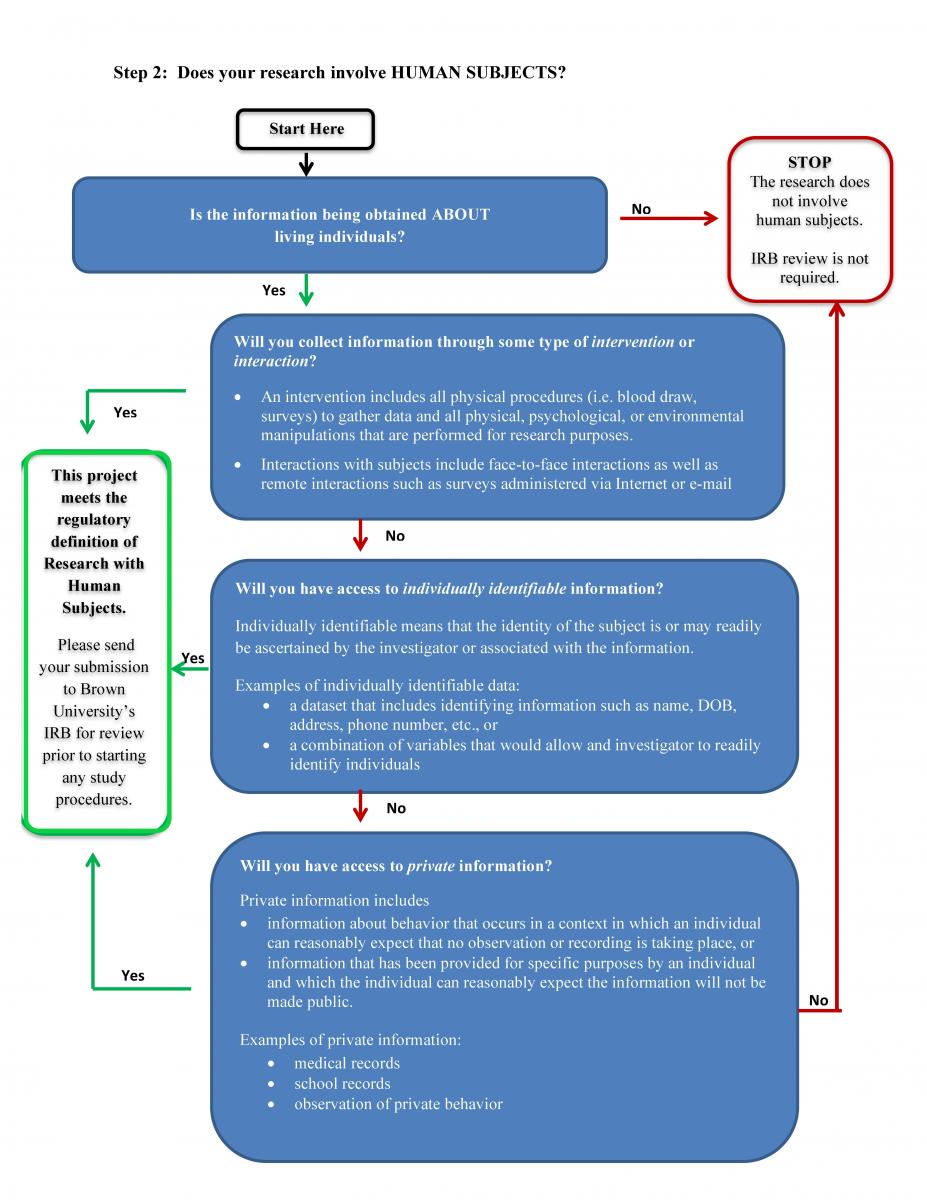
If your projection does non include human subjects, you do not need to submit an IRB application.
Comprehensive Comparison Tabular array
A comprehensive comparison table to assist students and researchers with distinguishing whether a project qualifies every bit human subject field enquiry, quality assurance/quality improvement, program evaluation, a student project or scholarly & journalistic activities.
HUMAN SUBJECT RESEARCH | QUALITY IMPROVEMENT OR Cess | PROGRAM EVALUATION | Educatee Project | SCHOLARLY & JOURNALISTIC ACTIVITIES | |
|---|---|---|---|---|---|
INTENT | Common Dominion: "Research means a systematic investigation, including research development, testing and evaluation, designed to develop or contribute to generalizable knowledge." Belmont Report: "[T]he term 'inquiry' designates an activity designed to examination a hypothesis, permit conclusions to be drawn, and thereby to develop or contribute to generalizable noesis (expressed, for example, in theories, principles, and statements of relationships). Research is ordinarily described in a formal protocol that sets forth an objective and a gear up of procedures designed to reach that objective." OHRP: "The question "what is enquiry" frequently arises in relation to an investigator or institutional activeness being planned to get together data to evaluate a specific program, such as a QA/QI activity. Although the conclusion as to whether the action will contribute to 'generalizable knowledge' is frequently based on whether the data volition be disseminated by means of publication or presentation, this should non be the sole factor used to make the determination. In full general, OHRP gives guidance that if the data will be used to draw conclusions related to a larger entity, then the activeness is considered 'inquiry'." | Intent of the project is to improve a practice or process inside a particular institution or ensure it conforms to expected norms. | Intent of the project is to evaluate a specific program, only to provide information for and about that programme. | Intent of the project is to provide an educational experience most the research process or methods | This category of activities concerns sure activities in various fields that focus directly on the specific individuals about whom data are collected (due east.chiliad., oral history, journalism, biography, literary criticism, legal research, and historical scholarship). Literary criticism …considering while a piece of literary criticism might focus on information about the author(s), it would typically focus on the specific author(s) in view. Legal research… because it would often focus on the circumstances of specific plaintiffs or parties involved in a instance. Information technology is not the item field that removes the activity from the definition [of HSR], only rather the item activity's focus on specific individuals. |
MOTIVATION FOR Projection | Project occurs in large part as a effect of private professional goals and requirements (e.thousand., seeking tenure; obtaining grants; completing a thesis or dissertation). | Projection occurs regardless of whether private(southward) conducting information technology may benefit professionally from conducting the project. | Project non initiated by the evaluator and occurs regardless of whether individual(s) conducting information technology may do good professionally from conducting the project. | Project occurs every bit function of assigned class/class work or a requirement of an educational program in gild to learn a new technique or pass a grade/fulfill an assignment. | Project occurs to portray the individuals involved. |
Blueprint | Designed to develop or contribute to the scientific storehouse of knowledge; may involve randomization of individuals to different treatments, regimens, or processes; novel research ideas or experimental activities that are non still known to be efficacious. May be designed to evidence a relationship or correlation. | Not designed to develop or contribute to generalizable knowledge; generally does non involve randomization to dissimilar practices or processes. | Not designed to develop or contribute to generalizable knowledge; does non involve randomization of individuals, but may involve comparison of variations in programs | Non designed to develop or contribute to generalizable knowledge; pattern is oftentimes an example or template provided past a professor or course book. | Designed to collect and use information nigh specific individuals themselves, and not generalizing to other individuals. |
MANDATE | Activities not mandated by institution or plan. | Activeness mandated by the institution or clinic equally part of its operations. | Activity mandated by the program, normally its funder, as part of its operations. | Activeness mandated by regularly assigned coursework or educational program | Activities non necessarily mandated by establishment or program |
Upshot ON PROGRAM OR Do EVALUATED | Findings of the written report are not expected to straight or immediately bear upon institutional or programmatic exercise, although they may also be used for this purpose. Activity will be used to develop a problem statement, research questions, and/or theory-based hypotheses. | Findings of the study are expected to directly affect institutional practice and identify corrective action(due south) needed. | Findings of the evaluation are expected to directly affect the carry of the program and identify improvements. | Findings of project are not expected to directly bear on the program; the projection will mainly generate raw information, not generalizable cognition. | N/A |
Discipline POPULATION | Human subject ways a living individual about whom an investigator (whether professional or educatee) conducting research obtains (1) Data through intervention or interaction with the private, or (2) Identifiable private information. May involve a subset of individuals; universal participation of an entire population (e.g., dispensary, program, or section) is uncommon; generally, statistical justification for sample size is used to ensure endpoints can exist met. | Information on all or nearly receiving a particular treatment or undergoing a item practise or process expected to be included; exclusion of information from some individuals significantly affects conclusions | Information on participants receiving a particular treatment or undergoing a particular practise or process expected to be used; exclusion of data from some individuals significantly affects conclusions | Can either include all, near, or a subset of individuals; statistical justification may exist used in the context to understand the process of field of study selection; however, recruitment often utilizes convenience sampling. | Preamble to revised Common Rule: "… the focus is on the specific activities that collect and employ data about specific individuals themselves, and not generalizing to other individuals, and that such activities occur in diverse fields of enquiry and methodological traditions… It is not the particular field that removes the activity from the definition, but rather the particular activity's focus on specific individuals." |
BENEFITS | Participants may or may not do good directly – benefit, if any, to individuals is likely to be incidental or delayed. | Participants expected to benefit directly from the activities. | No benefit to participants expected; evaluation concentrates on program improvements or whether the program should continue. | Participants may or may not benefit directly; do good is primarily for the student conducting the projection for the fulfillment of educational requirements. | Individual benefit may or may not be anticipated. |
Broadcasting OF RESULTS | Intent to publish or present generally presumed at the outset of projection equally part of professional expectations, obligations; dissemination of information usually occurs in enquiry/scientific publications, grant proposals, or other inquiry/scientific forum; results expected to develop or contribute to generalizable knowledge by filling a gap in scientific knowledge or supporting, refining, or refuting results from other inquiry studies. Results of the project volition exist disseminated exterior the institution for the purpose of sharing the outcomes or implications of the projection, not just the process. | Intent to publish or present generally non presumed at the outset of the project; dissemination of information often does not occur beyond the institution evaluated; dissemination of information may occur in quality improvement publications; when published or presented to a wider audience, the intent is to advise potentially effective models, strategies, assessment tools or provide benchmarks or base rates rather than to develop or contribute to generalizable cognition. | Intent to publish or present generally presumed at the outset of the project; broadcasting of data to program stakeholders and participants; may be publicly posted (due east.thousand., website) to ensure transparency of results; when published or presented to a wider audience, the intent is to advise potentially effective models, strategies, assessment tools or provide benchmarks or base rates rather than to develop or contribute to generalizable knowledge. | Whatever presentations, posters, or publishing (including online) is just to document the educational experience or completion of programmatic requirements. | Intent to publish or present generally presumed at the outset of the project; dissemination of information occurs to document a specific historical effect or the experiences of individuals without intent to draw conclusions or generalize findings. |
Definitions
Data about living individuals through intervention or interaction
An intervention may be physical procedures (e.g. venipuncture) or manipulations of living individuals or the living individuals' environments.
An interaction may be communication or interpersonal contact between the investigator (or enquiry squad) and the living private. Examples include interviews, questionnaires, surveys, observations, manipulations of subject behavior, nutrition, or environment, physical measurements, specimen drove (due east.chiliad. blood tissue), and administration of experimental drugs or devices.
Why "nigh whom" is fundamental
Consider if the projection focuses on the person or if the focus is on policies, practices or procedures about which the person is knowledgeable. Projects which collect information about policies, practices or procedures – even if the person who provided that information is identified – do not institute human discipline enquiry. Asking a person about someone else does not brand that person a human being subject.
Identifiable private data most living individuals
Identifiable means 1) the identity of the individual from whom the information was obtained is ascertained or may be readily ascertained past the investigator; or 2) the identity of the individual from whom the information was obtained is associated or may be readily associated with the information.
Individual Information is information about behavior that occurs in a context in which the individual can reasonably expect that no observation or recording is taking place or information that has been provided for specific purposes that the individual can reasonably expect will not be made public (e.g. medical record, employee or student records).
Examples of identifiable, private information include the discipline's name, address, phone number, social security number, medical record number, student or employee identification number, or in some cases, the combination of data such that they can identify a single individual through deductive reasoning. For example, information about employer, chore title, historic period and gender may not individually identify a subject, but when combined, could in sure cases, identify a specific individual.
What is NOT considered identifiable, private information: If the information cannot be linked to a living individual, or is considered public or is given with the expectation that it will exist fabricated public and that information technology will be linked to the private (e.g. biography or news story), then it would non be considered private identifiable information. For case, use of a publicly bachelor data set that does non contain identifiers or codes linked to individuals does not involve homo subjects research. Nonetheless, use of a publicly available data set that does contain identifiers or codes linked to individuals does involve human subject research.
If you obtain/buy/are given specimens/cells/material/data that has already been collected by someone else for another purpose, and the specimens/cells/fabric/information are not linked to whatsoever identifiers that would get in reasonably possible to identify an private, the activeness is not considered research with human subjects.
If your action does non involve homo subjects as defined in the regulations, your activity does not fall under the purview of the IRB. You do non need to submit an application.
If you accept determined that your inquiry does run into the federal definition for human subjects research, you will demand to utilise for IRB review and blessing before yous begin (the IRB tin can not review projects retrospectively).
All the same unsure or require documentation that your projection does not need IRB review?
If you are unsure if your projection meets the definition of research, or if y'all crave documentation that your project does not require IRB review, please contact the HRPP at (401) 863-3050 or [email protected] to talk over. If y'all are a student, we strongly encourage you lot to outset work with your counselor / mentor to discuss whether the proposed project meets the definition of man subjects research before contacting the HRPP.
Questions?
If you have questions, delight contact us at 401-863-3050 or [email protected].
Source: https://www.brown.edu/research/irb-review

Postar um comentário for "Which of the Following Activities Does Not Require Irb Review?"